The Two Major Events That Shaped the Early to Mid-20th Century Family Are

The history of the family is a co-operative of social history that concerns the sociocultural development of kinship groups from prehistoric to modernistic times.[1] The family has a universal and basic role in all societies.[ii] Inquiry on the history of the family crosses disciplines and cultures, aiming to understand the structure and role of the family from many viewpoints. For example, sociological, ecological or economical perspectives are used to view the interrelationships between the individual, their relatives, and the historical time.[1] The study of family history has shown that family systems are flexible, culturally diverse and adaptive to ecological and economical weather.[3]
Definition of family [edit]
Family defined equally the co-residence and the organization past kinship are both integral in the development of the concept of the family. A co-residential group that makes up a household may share full general survival goals and a residence, simply may not fulfill the varied and sometimes ambiguous requirements for the definition of a family.
Historiography [edit]
The history of the family unit emerged every bit a split up field of history in the 1970s, with shut ties to anthropology and sociology.[4] The trend was especially pronounced in the U.S. and Canada.[v] It emphasizes demographic patterns and public policy. It is quite separate from genealogy, although, it often draws on the aforementioned primary sources such as censuses and family records.[6] According to an influential pioneering study in 1978 called: Women, Work, and Family. The authors, Louise A. Tilly and Joan W. Scott, broke new ground with their broad interpretive framework and emphasis on the variable factors shaping the women's place in the family and economy in France and England. It has considered the interaction of production and reproduction in an analysis of the women'due south wage labor and thus helped to join labor and family history.[7] Much piece of work has been done on the dichotomy in women's lives between the private sphere and the public.[viii] For a contempo worldwide overview covering 7000 years see Maynes and Waltner (2012).[ix]
History of babyhood [edit]
The history of childhood is a growing subfield.[ten] [xi]
Family history science [edit]
- What is the proper unit for the written report of the history of the family — the private? Group? The civilization? The culture?
- Are there broad patterns and progress? How to present a universal family history?
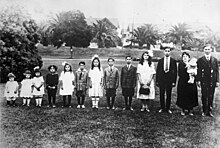
Historical perspectives of family studies
These are some approaches to the view of Family unit history:
- Ancient history : the family in ancient times until the Early Middle Ages.
- Anthropology: the family in cultural context.
- Archaeology: the study of the family unit culture.
- Fine art history: the family representation in visual art.
- Chronology: the science of localizing family/events in fourth dimension.
- Comparative history: the historical analysis of the family not bars to national boundaries.
- Gimmicky history: the written report of historical/social events that are immediately relevant to the nowadays time.
- Cultural history: the study of the family in the cultural context.
- Ethnography: the written report of family customs.
- Genealogy: names of people in lines of descent.
- Gender history: the family in the perspective of gender.
- Clearing: the study of the family and nationalities.
- Legal history: the report of the law of the family.
- Modern history: the written report of the modern family.
- Migration: the study of the family blueprint of global motility.
- People'south history: the family from the perspective of mutual people.
- Psychohistory: the written report of the psychological motivations of family events.
- Social history: the report of processes of social change.
- Theater history: the family representation in the theater arts.
- Women's history: the study of females and the family.
- World history: the study of the family from a global perspective.
Early scholars of family history applied Darwin's biological theory of development in their theory of the evolution of family systems.[12] American anthropologist, Lewis H. Morgan, published Aboriginal Social club in 1877, based on his theory of the three stages of homo progress, from savagery through barbarism, to culture.[13] Morgan'due south book was the "inspiration for Friedrich Engels' book", The Origin of the Family, Private Property, and the State, published in 1884.[fourteen] Engels expanded Morgan'south hypothesis that economic factors caused the transformation of primitive community into a class-divided society.[15] Engels' theory of resource command and later that of Karl Marx was used to explain the cause and effect of the change in family structure and role. The popularity of this theory was largely unmatched until the 1980s, when other sociological theories, specially structural functionalism, gained acceptance.[12]
The book, Centuries of Childhood by Philippe Ariès, published in France in 1960, had a not bad influence on the revival of the field of family unit history studies.[1] Ariès used the assay of demographic data to draw the conclusion that the concept of childhood was a concept that emerged in mod nuclear families.[1]
Research methodology [edit]
Since the early on 20th century, scholars have begun to unify methods of gathering data.[12] I notable book by Due west.I. Thomas and Florian Znaniecki, Polish Peasant in Europe and America (1918), was influential in establishing the precedence of a systematic longitudinal data analysis.[12] Gathering church files, court records, messages, architectural and archeological prove, art and iconography, and food and material culture increased the objectivity and reproducibility of the family reconstruction studies.[16] Studies of current family unit systems additionally utilize qualitative observations, interviews, focus groups, and quantitative surveys.[17] [18]
Family of origin [edit]
In well-nigh cultures of the world, the beginning of family history is set in creation myths.[19] In Works and Days, the aboriginal Greek poet Hesiod describes the epic devastation of four previous Ages of Human being.[20] The utopia that was the Golden Age was eventually replaced by the current Iron Age; a time when gods made human being live in "hopeless misery and toil."[twenty] Hesiod's second poem Theogony, described the Greek gods' relationships and family ties.[21] Ancient Greeks believed that amongst them, were descendants of gods who qualified for priesthood or other privileged social status.[22]
The Judeo-Christian tradition originates in the Bible'southward Volume of Genesis. The first man and woman created by God gave rise to all of the humanity. The Bible reflects the patriarchal worldview and often refers to the practice of polygamy. In biblical times, men sought to prove their descent from the family unit of the prophet Moses in order to be accepted into the priesthood.[22]
Roman families would include everyone within a household under the authoritarian role of the male parent, the pater familias; this included grown children and the slaves of the household.[23] Children born outside of marriage, from common and legal concubinage, could not inherit the father'south belongings or name; instead, they vest to the social group and family unit of their mothers'.[24]
Most ancient cultures similar those of Assyria, Egypt, and China, kept records of successors in the ruling dynasties to legitimize their ability as divine in origin.[22] Both the Inca male monarch and the Egyptian Pharaoh claimed that they were direct descendants of the Sun God,[22] and until the British Civil War, monarchs in England were considered 2nd only to God and as God's representative on earth.[25] Many other cultures, such every bit the Inca of South America, the Kinte of Africa, and the Māori of New Zealand, did not have a written language and kept the history of their descent every bit an oral tradition.[22]
Many cultures used other symbols to document their history of descent.[22] The totem poles are indigenous to the people of the Pacific Northwest. The symbolic representation of the pole goes back to the history of their ancestors and the family identity, in add-on to being tied with the spiritual world.[22]
European nobility had long and well-documented kinship relationships, sometimes taking their roots in the Center Ages.[22] In 1538, King Henry VIII of England mandated that churches begin the tape-keeping practice that soon spread throughout Europe.[22] Great britain's Domesday Book from 1086, is one of the oldest European genealogy records. In aboriginal and medieval times, the history of one'southward ancestors guaranteed religious and secular prestige.[22]
Christian culture puts notable emphasis on the family unit.[26] There were two singled-out family patterns that emerged in Christian Europe throughout the Middle Ages. In most of Southern and Eastern Europe, marriage occurred betwixt ii individuals who had lived with their parents for a long period of fourth dimension. The man involved was older, usually in his late twenties, and the girl was frequently still a teenager. Their household would contain several generations, an occurrence demographers denote as a "circuitous" household. In contrast, areas in Northwestern Europe gave rise to a familial structure that was unique for the time period. The man and adult female were typically around the same age, and would wait until they were in their early twenties to ally. Following the marriage, the couple would set up their ain contained household (termed a "nuclear" household structure). This led to a lower birthrate, as well as greater levels of economic stability for the new couple. This also served as a check on the increasing population in Europe. Many women in this region during this time period would never marry at all.[27]
In 1632, Virginia was the commencement country in the New World mandating a civil law that christenings, marriages, and burials were to exist recorded.[22] Historians of the family have made extensive employ of genealogical information of the sort collected by organizations of descendants such every bit the National Society of Old Plymouth Colony Descendants, The Club of Mayflower Descendants, Daughters of the American Revolution, National Society Sons of the American Revolution, and Society of the Descendants of the Founding Fathers of New England.[28] [29] The Cambridge Group for the History of Population and Social Structure, a major scholarly organisation in England founded in 1964, regularly consulted genealogists in developing their database for the history of the English language family and statistical analysis of long-term demographic trends.[30]
Development of household [edit]
The organization of the pre-industrial family is at present believed to be similar to modern types of family.[31] Many sociologists used to believe that the nuclear family was the product of industrialization, but evidence highlighted past historian Peter Laslett suggests that the causality is reversed and that industrialization was so effective in North-western Europe specifically because the pre-existence of the nuclear family fostered its evolution.[32]
Family types of pre-industrial Europe belonged into ii basic groups, the "elementary household arrangement" (the nuclear family), and the "joint family system" (the extended family).[32] A simple household arrangement featured a relatively late age of marriage for both men and women and the establishment of a dissever household subsequently the marriage or neolocality.[32] A articulation family household system was characterized by earlier spousal relationship for women, co-residence with the husband's family or patrilocality, and co-residing of multiple generations. Many households consisted of unrelated servants and apprentices residing for periods of years, and at that fourth dimension, belonging to the family.[31] Due to shorter life expectancy and high mortality rates in the pre-industrialized world, much of the construction of a family unit depended on the average historic period of the matrimony of women. Late marriages, as occurred in the elementary household arrangement, left little time for iii-generation families to course. Conversely, in the joint family household system, early marriages allowed for multi-generational families to grade.[32]
The pre-industrial family had many functions including nutrient production, landholding, regulation of inheritance, reproduction, socialization and pedagogy of its members. External roles allowed for participation in religion and politics.[33] Social status was also strictly connected to ane's family.[34]
Additionally, in the absenteeism of government institutions, the family was the only resources to cope with sickness and aging.[33] Considering of the industrial revolution and new work and living conditions, families changed, transferring to public institutions responsibleness for nutrient production and the education and welfare of its aging and sick members.[35] Mail service-industrial families became more private, nuclear, domestic and based on the emotional bonding between husband and wife, and between parents and children.[35]
Historian Lawrence Rock identifies three major types of family structure in England: in about 1450–1630, the open lineage family dominated. The Renaissance era, 1550–1700, brought the restricted patriarchal nuclear family. The early on modernistic world 1640-1800 emphasized the closed domesticated nuclear family unit.[36] Stone's conclusions have been disputed past other historians;[37] Peter Laslett and Alan MacFarlane believe the nuclear family unit became common in England beginning in the thirteenth century.[38]
Post-materialist and postmodern values accept become research topics related to the family unit.[39] According to Judith Stacy in 1990, "We are living, I believe, through a transitional and contested period of family history, a catamenia 'later' the modern family order."[xl] As of 2019, in that location are more than than 110 one thousand thousand single people in the United States. More than 50% of the American developed population is single compared to 22% in 1950. Jeremy Greenwood, Professor of economics at the University of Pennsylvania has explored how technological progress has affected the family. In particular, he discusses how technological advance has led to more married women working, a decline in fertility, an increment in the number of single households, social change, longer lifespans, and a rise in the fraction of life spent in retirement.[41] Sociologist Elyakim Kislev lists some of the major drivers for the decline in the family unit institution: women'due south growing independence, risk aversion in an historic period of divorce, demanding careers, ascent levels of education, individualism, secularization, popular media, growing transnational mobility, and urbanization processes.[42]
See also [edit]
Notes [edit]
- ^ a b c d Hareven 1991, p. 95.
- ^ van den Berghe 1979, p. sixteen.
- ^ van den Berghe 1979, p. 50.
- ^ Tamara Thousand. Hareven, "The history of the family unit and the complexity of social change," American Historical Review, Feb 1991, Vol. 96 Issue i, pp. 95-124
- ^ Cynthia Comacchio, "'The History of United states of america': Social Science, History, and the Relations of Family in Canada," Labour / Le Travail, Fall 2000, Vol. 46, pp. 167-220, with very thorough coverage.
- ^ see Periodical of Family History, quarterly since 1976
- ^ Thomas Dublin, "Women, Work, and Family unit: The View from the United States," Periodical of Women's History, Autumn 99, Vol. 11 Issue iii, pp 17-21
- ^ D'Ann Campbell, Women at War with America: Private Lives in a Patriotic Era (1984)
- ^ Mary Jo Maynes and Ann Beth Waltner, The Family: A Globe History (Oxford University Printing, 2012) online review
- ^ Peter N. Stearns, "Social History and Globe History: Prospects for Collaboration." Journal of World History 2007 18(1): 43-52. in Projection Muse, deals with the history of childhood worldwide. See Peter Northward. Stearns, Childhood in World History (2005), A.R. Colon with P. A. Colon, A History of Children: A Socio-Cultural Survey across Millennia (2001), and Steven Mintz, Huck'southward Raft: A History of American Childhood (2006).
- ^ Joseph M. Hawes and N. Ray Hiner, "Hidden in Manifestly View: The History of Children (and Babyhood) in the Twenty-First Century," Journal of the History of Babyhood & Youth, Jan 2008, Vol. 1 Issue 1, pp 43-49
- ^ a b c d "Sociology/Founding the discipline". Encyclopædia Britannica. Retrieved 2009-07-26 .
- ^ Morgan 1877
- ^ Encyclopedia, Britannica. "Cultural Anthropology". Retrieved 2009-07-22 .
- ^ "The Marxists Net Archive". Retrieved 2009-07-17 .
- ^ Wrigley 1977, p. 74.
- ^ Daly 2007.
- ^ Bengston 2006.
- ^ Rosenberg 1986
- ^ a b Hesiod 1985.
- ^ Hesiod 1997
- ^ a b c d e f g h i j thou Potter-Phillips, Donna. "History of Genealogy". Family Chronicle. Archived from the original on 2010-05-28. Retrieved 2009-07-26 .
- ^ "The Illustrated History of the Roman Empire". Archived from the original on 2015-11-01. Retrieved 2009-07-17 .
- ^ Letourneau 1904.
- ^ Phillip, Walter Alison. "King § Divine Correct of Kings". In Chisholm, Hugh (ed.). Encyclopædia Britannica. 15 (11th ed.). Cambridge Academy Press. p. 806.
- ^ Rawson, Beryl Rawson (2010). A Companion to Families in the Greek and Roman Worlds. John Wiley & Sons. p. 111. ISBN9781444390759.
Christianity placed great accent on the family and on all members from children to the aged
- ^ Wiesner, Merry E. "The Family unit." Gender in History: Global Perspectives, Wiley-Blackwell, 2011, p. 38.
- ^ John W. Adams and Alice Bee Kasakoff, "Migration and the family in colonial New England: The view from genealogies." Journal of Family History ix.ane (1984): 24-43.
- ^ Lloyd DeWitt Bockstruck, "Four Centuries of Genealogy: A Historical Overview." RQ 23#2 (1983): 162-lxx. online.
- ^ Robert M. Taylor; Ralph J. Crandall (1986). Generations and Modify: Genealogical Perspectives in Social History. Mercer Upward. pp. xviii–xx. ISBN9780865541689.
- ^ a b Hareven 1991.
- ^ a b c d Kretzer 2002.
- ^ a b Hareven 1991, p. 96.
- ^ Wrigley 1977, p. 72.
- ^ a b Hareven 1991, p. 120.
- ^ Lawrence Stone, The Family, Sex, and Marriage in England 1500-1800 (1977)
- ^ Review by of Stone'southward book by Alan Macfarlane, 2002
- ^ The Real Roots of the Nuclear Family
- ^ Kislev, Elyakim. (2017-09-01). "Happiness, Post-materialist Values, and the Single". Periodical of Happiness Studies. doi:10.1007/s10902-017-9921-7. ISSN 1573-7780.
- ^ Marvin B. Sussman; Suzanne Chiliad. Steinmetz; Gary West. Peterson (2013). Handbook of Marriage and the Family. Springer. p. 209. ISBN9781475753677.
- ^ Greenwood, Jeremy (2019). Evolving Households: The Banner of Technology on Life. The MIT Press. ISBN9780262039239.
- ^ Kislev, Elyakim (2019). Happy Singlehood: The Ascent Credence and Celebration of Solo Living. Academy of California Press.
References [edit]
- Bengtson, Vern 50.; Alan C. Acock; David M. Klein; Katherine R. Allen; Peggye Dilworth-Anderson (2006). Sourcebook of family theory & enquiry. SAGE. ISBNone-4129-4085-0.
- Coleman, Marilyn and Lawrence Ganong, eds. The Social History of the American Family: An Encyclopedia (4 vol, 2014). 600 articles past scholars; 2144pp; extract
- Daly, Kerry (2007). Qualitative methods for family studies & human development. SAGE. ISBN978-1-4129-1402-iv.
- Ellens, J. Harold (2006). Sex in the Bible: a new consideration. Greenwood Publishing Group. ISBN0-275-98767-1.
- Field, Corinne T., and Nicholas L. Syrett, eds. Historic period in America: The Colonial Era to the Present (New York University Press, 2015). viii, 338 pp.
- Greenwood, Jeremy (2019). Evolving Households: The Imprint of Engineering science on Life. The MIT Press. ISBN9780262039239.
- Hanson, M. C.; Douglas Due east. Oakman (2002). Palestine in the Time of Jesus: Social Structures and Social Conflicts. Fortress Press. ISBN0-8006-3470-5.
- Hareven, Tamara K. (Feb 1991). "The History of the Family and the Complexity of Social Change". The American Historical Review. American Historical Association. 96 (one): 95–124. doi:10.2307/2164019. JSTOR 2164019.
- Hesiod; Thomas Alan Sinclair (1985). Works and days. Georg Olms Verlag. ISBN3-487-05414-0.
- Hesiod; Yard. Fifty. West (1997). Theogony. NetLibrary, Incorporated. ISBN0-585-34339-X.
- Kertzer, David I. (1991). "Household History and Sociological Theory". Almanac Review of Sociology. Annual Reviews. 17 (1): 155–179. doi:10.1146/annurev.and then.17.080191.001103. JSTOR 2083339.
- Kertzer, David I.; Marzio Barbagli (2002). The History of the European Family: Family life in the long nineteenth century (1789-1913) . Yale University Press. ISBN0-300-09090-0.
- Letourneau, Charles (1904). The Evolution of Marriage and of the Family. Scott Pub. Co.
- Mousourakis, George (2003). The historical and institutional context of Roman police. Ashgate Publishing, Ltd. ISBN0-7546-2114-6.
- Rosenberg, Donna (2001). World mythology: an anthology of the bang-up myths and epics. NTC Pub. Group. ISBN0-8442-5966-7.
- Thomas, William; Florian Znaniecki (1996). The Polish Peasant in Europe and America: A Classic Work in Clearing History. Urbana: University of Illinois Press. ISBN0-252-06484-4.
- van den Berghe, Pierre (1979). Human family systems: an evolutionary view. Elsevier North Kingdom of the netherlands, Inc. ISBN0-444-99061-5.
- Wrigley, Eastward. Anthony (Spring 1997). "Reflections on the History of the Family". The Family unit. The MIT Press. 106 (2): 71–85. JSTOR 20024477.
Source: https://en.wikipedia.org/wiki/History_of_the_family
0 Response to "The Two Major Events That Shaped the Early to Mid-20th Century Family Are"
Postar um comentário