Which Artist Had Help From Gang Memebers to Help Their Art
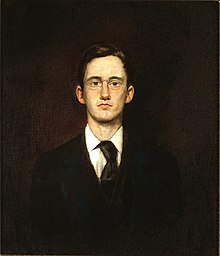
The Ashcan School, besides called the Ash Can School, was an artistic motility in the U.s. during the late 19th-early 20th century[i] that is all-time known for works portraying scenes of daily life in New York, often in the city's poorer neighborhoods.
The all-time known artists working in this fashion included Robert Henri (1865–1929), George Luks (1867–1933), William Glackens (1870–1938), John Sloan (1871–1951), and Everett Shinn (1876–1953). Some of them met studying together nether the renowned realist Thomas Anshutz at the Pennsylvania Academy of the Fine Arts; others met in the newspaper offices of Philadelphia where they worked every bit illustrators. Theresa Bernstein, who studied at the Philadelphia School of Design for Women, was likewise a part of the Ashcan School. She was friends with many of its better-known members, including Sloan with whom she co-founded the Society of Independent Artists.
The movement, which took some inspiration from Walt Whitman's epic verse form Leaves of Grass, has been seen as emblematic of the spirit of political rebellion of the period.[2]
Origin and development [edit]
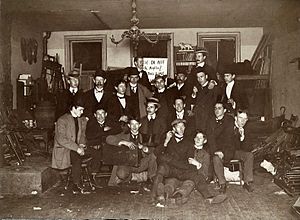
Ashcan School artists and friends at John French Sloan's Philadelphia Studio, 1898
The Ashcan School was not an organized movement. The artists who worked in this way did not issue manifestos or fifty-fifty see themselves as a unified group with identical intentions or career goals. Some of the artists were politically minded, and others were apolitical. Their unity consisted of a desire to tell sure truths about the metropolis and modern life they felt had been ignored by the suffocating influence of the Genteel Tradition in the visual arts. Robert Henri, in some ways the spiritual father of this school, "wanted fine art to be akin to journalism... he wanted pigment to be as real every bit mud, as the clods of equus caballus-shit and snow, that froze on Broadway in the winter."[three] He urged his younger friends and students to pigment in the robust, unfettered, ungenteel spirit of his favorite poet, Walt Whitman, and to be unafraid of offending contemporary gustation. He believed that working-grade and middle-class urban settings would provide meliorate material for modernistic painters than drawing rooms and salons. Having been to Paris and admired the works of Édouard Manet, Henri also urged his students to ''paint the everyday globe in America just as it had been done in French republic.''[iv]
The name "Ashcan school" is a natural language-in-cheek reference to other "schools of art". Its origin is in a complaint found in a publication chosen The Masses alleging that there were too many "pictures of ashcans and girls hitching up their skirts on Horatio Street." That item reference was published in The Masses at a point at which the artists had already been working together for most 8 years. They were amused by the reference and the proper name stuck.[5] (For examples of other "schools of fine art" run across Category:Italian fine art movements eastward.m. Lucchese School and for instance School of Paris.) The Ashcan Schoolhouse of artists had also been known as "The Apostles of Ugliness".[6] The term Ashcan School was originally applied in derision. The schoolhouse is non so much known for innovations in technique but more than for its discipline matter. Common subjects were prostitutes and street urchins. The work of the Ashcan painters links them to such documentary photographers every bit Jacob Riis and Lewis W. Hine. Several Ashcan School painters derived from the surface area of print publication at a time earlier photography replaced paw-fatigued illustrations in newspapers. They were involved in journalistic pictorial reportage earlier concentrating their energies on painting. George Luks one time proclaimed "I can paint with a shoestring dipped in pitch and lard." In the mid-1890s Robert Henri returned to Philadelphia from Paris very unimpressed past the work of the late Impressionists and with a determination to create a type of art that engaged with life.[7] He attempted to imbue several other artists with this passion. The school has even been referred to equally "the revolutionary black gang", a reference to the artists' dark palette. The grouping was subject field to attacks in the press and ane of their earliest exhibitions, in 1908 at New York's Macbeth Gallery, was a success.[8]
Many of the most famous Ashcan works were painted in the showtime decade of the century at the same time in which the realist fiction of Stephen Crane, Theodore Dreiser, and Frank Norris was finding its audition and the muckraking journalists were calling attending to slum conditions.[9] The first known use of the term "ash can art" is credited to artist Art Young in 1916.[10] The term past that time was applied to a large number of painters beyond the original "Philadelphia 5," including George Bellows, Glenn O. Coleman, Jerome Myers, Gifford Beal, Eugene Higgins, Carl Springchorn and Edward Hopper. (Despite his inclusion in the group by some critics, Hopper rejected their focus and never embraced the label; his depictions of city streets were painted in a different spirit, "with not a unmarried incidental ashcan in sight.")[eleven] Photographers like Jacob Riis and Lewis Hine were also discussed as Ashcan artists. Like many fine art-historical terms, "Ashcan art" has sometimes been applied to and so many unlike artists that its meaning has become diluted.
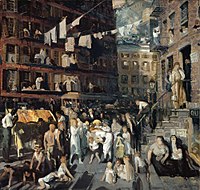
The artists of the Ashcan School rebelled confronting both American Impressionism and academic realism, the two most respected and commercially successful styles in the US at the end of the 19th century and the beginning of the 20th century. In contrast to the highly polished work of artists like John Singer Sargent, William Merritt Chase, Kenyon Cox, Thomas Wilmer Dewing, and Abbott Thayer, Ashcan works were mostly darker in tone and more roughly painted. Many captured the harsher moments of mod life, portraying street kids (e.thousand., Henri'due south Willie Gee and Bellows' Paddy Flannagan), prostitutes (due east.g., Sloan'due south The Haymarket and Three A.M.), alcoholics (due east.k., Luks' The Old Duchess), indecorous animals (eastward.g., Luks' Feeding the Pigs and Adult female with Goose), subways (east.g., Shinn'due south Sixth Artery Elevated Later Midnight), crowded tenements (e.grand., Bellows' Cliff Dwellers), washing hung out to dry (Shinn'due south The Laundress), boisterous theaters (e.g., Glackens' Hammerstein'southward Roof Garden and Shinn'southward London Hippodrome), bloodied boxers (e.g., Bellows' Both Members of This Club), and wrestlers on the mat (e.yard., Luks' The Wrestlers). It was their frequent, although not exclusive, focus upon poverty and the gritty realities of urban life that prompted some critics and curators to consider them as well unsettling for mainstream audiences and collections.
The advent of modernism in the Us spelled the end of the Ashcan school's provocative reputation. With the Arsenal Show of 1913 and the opening of more galleries in the 1910s promoting the work of Cubists, Fauves, and Expressionists, Henri and his circle began to appear tame to a younger generation. Their rebellion was over non long later on it began. It was the fate of the Ashcan realists to be seen by many art lovers as too radical in 1910 and, by many more, every bit old-fashioned by 1920.
Connection to "The 8" [edit]
The Ashcan schoolhouse is sometimes linked to the group known as "The Viii", though in fact only 5 members of that group (Henri, Sloan, Glackens, Luks, and Shinn) were Ashcan artists.[12] The other iii – Arthur B. Davies, Ernest Lawson, and Maurice Prendergast – painted in a very different style, and the exhibition that brought "The Viii" to national attention took place in 1908, several years after the beginning of the Ashcan style. However, the attending accorded the grouping's well-publicized exhibition at the Macbeth Galleries in New York 1908 was such that Ashcan art gained wider exposure and greater sales and critical attention than information technology had known before.
The Macbeth Galleries exhibition was held to protest the restrictive exhibition policies of the powerful, conservative National University of Design and to broadcast the need for wider opportunities to brandish new art of a more diverse, adventurous quality than the Academy generally permitted. When the exhibition closed in New York, where information technology attracted considerable attention, it toured Chicago, Toledo, Cincinnati, Indianapolis, Pittsburgh, Bridgeport, and Newark in a traveling show organized by John Sloan.[13] Reviews were mixed, only interest was high. ("Large Sensation at the Art Museum, Visitors Bring together Throng Museum and Bring together Hot Word," i Ohio newspaper noted.)[14] As art historian Judith Zilczer summarized the venture, "In taking their fine art directly to the American public, The Eight demonstrated that cultural provincialism in the United States was less pervasive than contemporary and subsequent accounts of the period had inferred."[fifteen] Sales and exhibition opportunities for these painters increased significantly in the ensuing years.
Gallery [edit]
-

Thomas Pollock Anshutz, The Farmer and His Son at Harvesting, 1879. V members of the Ashcan School studied with him, simply went on to create quite different styles.
-

-

-

-

-

-
-

Jacob Riis, Brigand's Roost, 1888, (photo), considered the most crime-ridden, unsafe role of New York City.
-

-

-

-

-

See too [edit]
- American realism
- Realism (visual arts)
Notes [edit]
- ^ Ashcan School Exhibition - First Fine art Museum
- ^ Glen Jeansonne (9 June 1997). Women of the Far Right: The Mothers' Movement and World State of war II. University of Chicago Printing. p. 4. ISBN978-0-226-39589-0.
- ^ Robert Hughes, American Visions BBC-Boob tube series (ep.5 - "The Wave From The Atlantic")
- ^ "Art From the Alleys". The Cranium . Retrieved nineteen March 2019.
- ^ www.khanacademy.org
- ^ Fine art in the mod era: A guide to styles, schools, & movements, Amy Dempsey, Abrams, 2002. (U.Southward. edition of Styles, Schools and Movements) ISBN 978-0810941724
- ^ Art in the modernistic era: A guide to styles, schools, & movements, Amy Dempsey, Abrams, 2002. (U.S. edition of Styles, Schools and Movements) ISBN 978-0810941724
- ^ Art in the mod era: A guide to styles, schools, & movements, Amy Dempsey, Abrams, 2002. (U.S. edition of Styles, Schools and Movements) ISBN 978-0810941724
- ^ Sam Hunter, Modern American Painting and Sculpture (New York: Dell, 1959), 28–40.
- ^ John Loughery, John Sloan: Painter and Rebel (New York: Henry Holt, 1997), pp. 218–219
- ^ Wells, Walter, Silent Theater: The Art of Edward Hopper (London/New York: Phaidon, 2007).
- ^ The Ashcan School, The Eight and the New York Art Earth|The Metropolitan Museum of Art
- ^ Loughery, p. 127, 134–140.
- ^ Loughery, p. 135.
- ^ Judith Zilczer, "The Eight on Tour," American Art Journal, 16, no. 3 (Summer 1984), p. 38.
Sources [edit]
- Brown, Milton. American Painting from the Armory Show to the Depression. Princeton: Princeton University Press, 1955.
- Brooks, Van Wyck. John Sloan: A Painter'southward Life. New York: Dutton, 1955.
- Doezema, Marianne. George Bellows and Urban America. New Haven: Yale Academy Press, 1992.
- Glackens, Ira. William Glackens and the Ashcan School: The Emergence of Realism in American Art. New York: Crown, 1957.
- Homer, William Innes. Robert Henri and His Circle. Ithaca: Cornell Academy Printing, 1969.
- Hughes, Robert. American Visions: The Epic Story of Art in America. New York: Knopf, 1997.
- Hunter, Sam. Modern American Painting and Sculpture. New York: Dell, 1959.
- Kennedy, Elizabeth (ed.). The Viii and American Modernisms. Chicago: University of Chicago Press, 2009.
- Loughery, John. John Sloan: Painter and Insubordinate. New York: Henry Holt, 1997. ISBN 0-8050-5221-6
- Perlman, Bennard (ed.), introduction past Mrs. John Sloan. Revolutionaries of Realism: The Letters of John Sloan and Robert Henri. Princeton: Princeton University Press, 1997.
External links [edit]
- Documenting the Aureate Age: New York Metropolis Exhibitions at the Turn of the 20th Century A New York Art Resources Consortium project. Exhibition catalogs, checklists, and photoarchive material.
- Collection: "Ashcan School" from the University of Michigan Museum of Art
 Media related to Ashcan School at Wikimedia Commons
Source: https://en.wikipedia.org/wiki/Ashcan_School
0 Response to "Which Artist Had Help From Gang Memebers to Help Their Art"
Postar um comentário